- May 24, 2026
- 10 min read
SASHIMI
Table of Contents
Two of the most refined expressions of raw fish in the culinary world come from opposite ends of the globe. Japanese sashimi and Italian crudo both place raw fish at the center of the plate and both depend entirely on the quality of what they are working with. Beyond those two points of common ground, they represent fundamentally different philosophies about what raw fish is for and how it should be experienced.
Understanding sashimi vs crudo deepens your appreciation of both and gives you a clearer framework for evaluating each on its own terms.
1. What Sashimi Is and What It Is Designed to Do
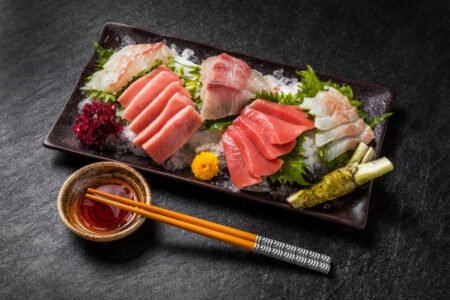
Sashimi is the Japanese practice of serving thinly sliced raw fish or seafood without rice, accompanied by minimal condiments. Its fundamental design principle is subtraction. Every decision in sashimi preparation is made in service of removing anything that might interfere with the direct experience of the fish itself.
The knife cut is executed to preserve the cellular structure of the fish. The temperature is controlled so the fish arrives at the precise point between cold and room temperature where flavor is most expressive. The condiments, wasabi, soy sauce, shiso, and ginger, are calibrated to accent without competing. The presentation is arranged to honor the visual character of each species.
Sashimi in Japanese culinary tradition is rooted in the idea that great fish requires nothing added to it beyond the skill of the chef who handles it. The restraint is not a limitation. It is the entire point.
2. What Crudo Is and What It Is Designed to Do
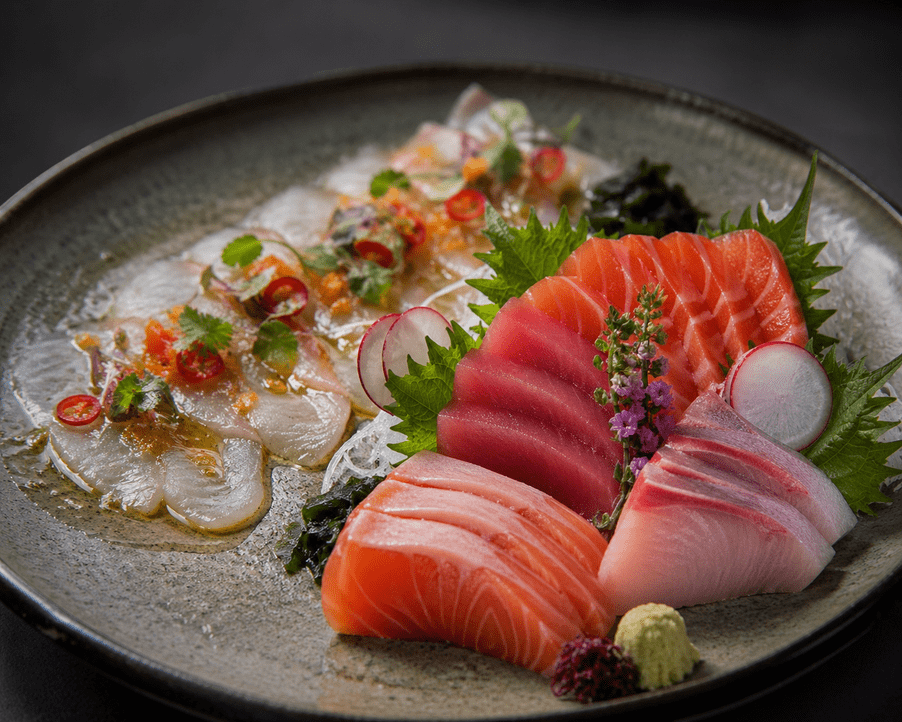
Crudo, which means raw in Italian, is the Italian approach to serving raw fish or seafood. Where sashimi subtracts, crudo adds. The design principle of crudo is enhancement through complementary flavors applied directly to the fish, typically in the form of high-quality olive oil, citrus, sea salt, and finishing elements like herbs, capers, thinly sliced vegetables, or chili.
Italian crudo is a dish built on the premise that raw fish is a canvas, and that the right combination of bright, acidic, and rich flavors applied with restraint can produce something greater than the fish alone. The citrus partially denatures the protein at the surface of the fish in a way that changes the texture subtly, a process similar to what occurs in ceviche though far less pronounced. The olive oil adds richness and carries other flavors across the surface of each piece.
Crudo is inherently more composed than sashimi in the culinary sense. It is a constructed dish where the accompaniments are as intentional as the fish itself.
3. The Role of the Knife in Sashimi vs Crudo
Both sashimi and crudo require skilled knife work, but the standards and techniques differ in meaningful ways.
Sashimi knife work is governed by a centuries-old tradition of precision cutting using the yanagiba, a long single-bevel blade designed to draw through fish in a single clean motion. The thickness of each slice, the angle of the cut relative to the grain of the fish, and the consistency across every piece on the plate are all elements of a standardized craft with deep historical roots. As explored in our post on what the sashimi knife cut tells you about the chef, the quality of that knife work is visible on the plate and communicates directly about the skill behind it.
Crudo knife work is less codified but no less important. Slices for crudo tend to be thinner than most sashimi cuts, sometimes approaching translucency, because the fish will be dressed with olive oil and citrus that carry flavor into the flesh. The cut must be clean enough that the dressing adheres evenly and the fish holds its visual integrity on the plate.
4. Fish Selection: Overlap and Divergence
Both preparations draw from many of the same species, and the overlapping species reveal something interesting about where the two traditions converge on quality.
Tuna appears in both traditions as a standard, reliable option whose clean flavor and firm texture suit either approach. Yellowtail works well in both contexts. Sea bass, known as branzino in Italian cuisine and suzuki in Japanese, is particularly well suited to crudo because its delicate flavor is enhanced by citrus and olive oil without being overwhelmed.
Where the traditions diverge most noticeably in fish selection is in the handling of fat. Sashimi celebrates fatty fish like toro or salmon in relatively thick cuts where the fat can be experienced directly. Crudo tends to use leaner fish in thinner preparations where the dressing provides the richness rather than the fish itself.
The emphasis in selecting fish for a sashimi platter, as covered in our post on how to read a sashimi platter and what every element is telling you, is on freshness, correct handling, and species-specific cutting technique. These priorities apply equally to crudo.
5. Temperature and Timing
Temperature is treated with equal seriousness in both traditions but for slightly different reasons.
Sashimi is served at a temperature close to room temperature, typically achieved by removing fish from refrigeration a controlled amount of time before service. Cold sashimi has muted flavor and a different texture than properly rested fish. The temperature management is entirely about maximizing the eating experience of the fish itself.
Crudo is typically served chilled or very lightly chilled because the dressing of olive oil and citrus benefits from a cool temperature that prevents the oil from becoming too fluid and the citrus from advancing the partial denaturation of the protein beyond the intended point. The temperature management in crudo is about controlling the interaction between the dressing and the fish.
Both approaches treat temperature as a variable that must be actively managed rather than ignored.
6. Which to Order and When
Sashimi vs crudo is not a question of which is better, and understanding the difference helps you choose between them when both appear on a menu.
If you want to experience the fish in its most direct, unmediated form, where the flavor of the species is the entire subject of the plate, order sashimi. The Japanese tradition of restraint is specifically designed to deliver that experience.
If you want the fish to serve as a foundation for a more composed flavor experience where citrus, oil, and herbs play an intentional supporting role, order crudo. The Italian tradition is designed to build something greater than the fish alone.
Neither is superior. They are different conversations happening in different culinary languages, both of which are worth learning to hear.
7. FAQs
What is the main difference between sashimi and crudo?
Sashimi is the Japanese practice of serving raw fish with minimal condiments, designed to present the fish with as little interference as possible. Crudo is the Italian practice of serving raw fish dressed with olive oil, citrus, and other flavoring elements that complement and enhance the fish. Sashimi subtracts. Crudo adds.
Do sashimi and crudo use the same types of fish?
There is significant overlap. Tuna, yellowtail, and sea bass appear in both traditions. The key difference is that sashimi tends to celebrate fatty fish in thicker cuts where the natural fat content is experienced directly, while crudo tends to use leaner fish in thinner preparations where the dressing provides richness.
Is crudo similar to ceviche?
Both crudo and ceviche use citrus on raw fish, but they differ significantly in the degree of citrus application. Ceviche uses enough citrus to fully denature the protein and cook the fish chemically over a period of time. Crudo uses citrus as a light finishing element that affects only the very surface of the fish without chemically cooking it.
Which preparation is better for experiencing the natural flavor of the fish?
Sashimi is specifically designed to present the fish in its most unmediated form. The Japanese principle of restraint in sashimi preparation removes anything that might compete with the flavor of the fish itself. If experiencing the natural character of a particular species is the goal, sashimi is the more direct vehicle for that experience.
Can sashimi and crudo be served at the same restaurant?
Yes, particularly in Japanese fusion or contemporary dining contexts where both traditions are represented on the menu. Ordering both in the same meal offers a direct comparison of how the same or similar fish behaves under two fundamentally different culinary philosophies.
8. Two Languages, One Subject
Sashimi and crudo are both conversations about the same thing: the extraordinary quality available in great raw fish when it is handled with skill and served with intention. They reach the same subject from opposite directions, and both are worth pursuing.
The next time a menu offers both, consider ordering each and experiencing the comparison directly. The contrast is one of the clearest illustrations of how culinary philosophy shapes the eating experience. For sashimi prepared with the attention and sourcing care the tradition deserves, explore what a sushi restaurant committed to authentic Japanese preparation looks like, and come taste the difference.
Key Takeaways
Sashimi and crudo are not rivals, they are two distinct culinary languages that both celebrate the extraordinary potential of exceptional raw fish, just from opposite directions. Sashimi, rooted in Japanese tradition, is an exercise in restraint: precise knife work, controlled temperature, and minimal accompaniment designed to let the fish speak entirely for itself. Crudo, born from Italian sensibility, is an exercise in harmony: the fish becomes a canvas where high-quality olive oil, citrus, and finishing elements are composed to create something greater than any single ingredient alone. Understanding this fundamental difference doesn’t just make you a more informed diner — it sharpens your ability to choose intentionally, appreciate what’s on your plate, and recognize the skill and philosophy behind every slice. Whether you prefer subtraction or addition, both traditions reward the same thing: quality, intention, and respect for the fish.
Experience the Difference for Yourself.
Reading about sashimi and crudo is one thing. Tasting the philosophy behind each slice is another. Our kitchen is committed to the craft from sourcing to the final cut so every plate tells the story it’s meant to tell.
DISCLAIMER: Consuming raw or undercooked seafood carries food safety risks. Individuals who are pregnant, elderly, immunocompromised, or have underlying health conditions should consult a healthcare provider before consuming raw seafood.