- August 9, 2026
- 10 min read
SUSHI
Table of Contents
- 1. The Problem With the Word Specialty
- 2. What a Specialty Sushi Roll Is Actually Supposed to Do
- 3. The Role of the Base in a Well-Built Roll
- 4. Fillings: Contrast Over Quantity
- 5. Toppings: Accent or Distraction
- 6. Sauce: The Most Misused Element in Modern Rolls
- 7. How Structure Affects the Eating Experience
- 8. What Separates a Thoughtful Roll From a Complicated One
- 9. How to Evaluate a Specialty Sushi Roll at the Table
- 10. Frequently Asked Questions
Every sushi menu has a specialty roll section. Some of those rolls genuinely deserve the designation. Others are elaborate in presentation but underwhelming in the eating, a collection of ingredients assembled more for visual impact than for how they work together in the mouth.
Understanding what makes a specialty sushi roll actually special gives you a much clearer lens for evaluating what is in front of you and a stronger basis for knowing when a roll justifies its place on the menu.
1. The Problem With the Word Specialty
The label specialty sushi roll has no fixed standard attached to it. Any kitchen can apply it to any roll, and many do. The word signals differentiation from the standard hosomaki or basic nigiri section of the menu, but it does not guarantee that the roll is better designed, better sourced, or more skillfully assembled than the simpler options surrounding it.
In some restaurants, specialty rolls are the creative and carefully constructed peak of the menu. In others, they are ordinary ingredients combined with heavy sauce and premium pricing. The word itself is not a reliable guide. What matters is understanding what the roll is doing and whether it is doing it well.
2. What a Specialty Sushi Roll Is Actually Supposed to Do
A well-designed specialty sushi roll has a clear flavor concept. Every ingredient present contributes something specific, whether that is richness, acidity, heat, crunch, or sweetness, and those contributions work together rather than competing with or canceling each other out.
The best specialty rolls are built around a central idea. A roll designed around the richness of salmon might use avocado to amplify that creaminess, a light citrus element to cut through it, and a small amount of tobiko for texture contrast. Every choice serves the central concept. Nothing is present simply to make the roll look more impressive or to justify a higher price point.
Japanese fusion cuisine at its best uses Western and international influences to expand the range of a dish while respecting the underlying principles of balance and restraint that define the cuisine. A specialty sushi roll that follows this principle tastes coherent. One that ignores it tastes busy.
3. The Role of the Base in a Well-Built Roll
The foundation of any specialty sushi roll is the rice, and this is where many elaborate rolls fall short. The visual spectacle of toppings, sauces, and garnishes can distract from the fact that the rice underneath is poorly seasoned, over-packed, or served at the wrong temperature.
Properly prepared sushi rice should hold its shape, release evenly when bitten, and carry a subtle vinegar tang that complements the other ingredients rather than disappearing beneath them. When the rice is right, it provides a clean, slightly tangy base that allows the fillings and toppings to register clearly. When the rice is wrong, every other element in the specialty sushi roll has to work harder to compensate, and nothing quite lands the way it should.
As covered in our post on what sets great sushi rolls apart from forgettable ones, the rice is the single most important variable in any roll, regardless of how many additional ingredients surround it.
4. Fillings: Contrast Over Quantity
The number of ingredients inside a specialty sushi roll is not a measure of its quality. More fillings do not produce a better roll. Better-chosen fillings do.
The most effective rolls use three to four interior components that each contribute something different to the eating experience. A combination of fish for protein and oceanic flavor, avocado for fat and creaminess, cucumber for crunch and freshness, and a small amount of something pickled for acidity covers the primary flavor and texture dimensions without overcrowding the roll.
Overcrowded rolls create two problems. The first is structural: a roll with too many fillings cannot be cut cleanly and tends to fall apart or compress unevenly. The second is sensory: too many flavors competing simultaneously produces a muddled eating experience where no individual ingredient registers clearly.
The restraint required to limit fillings to what genuinely contributes is a form of skill that distinguishes a thoughtfully designed specialty sushi roll from one assembled by adding ingredients until the roll looks impressive.
5. Toppings: Accent or Distraction
The topping layer of a specialty sushi roll is the most visible element and the one most prone to excess. When done well, toppings add a finishing dimension of flavor, texture, or color that elevates the roll as a whole. When done poorly, they bury everything beneath them.
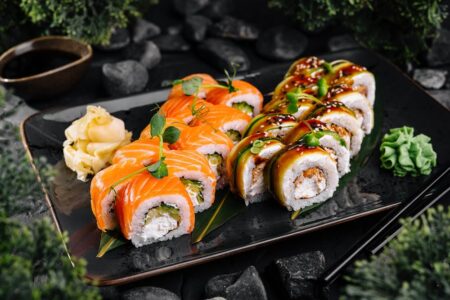
Effective toppings on a specialty sushi roll work at a small scale. A thin draping of sashimi-grade fish across the top of a roll adds richness and visual elegance without overwhelming the interior. A light scattering of tobiko adds a pop of texture and a faint brininess. Thinly sliced scallion or microgreens add freshness and color contrast that makes the roll visually striking without adding unnecessary bulk or competing flavors.
Toppings that pile up, overlap, and cover the roll completely tend to signal that the kitchen is using visual abundance to substitute for conceptual precision. A well-designed specialty sushi roll needs toppings that accent, not toppings that hide.
6. Sauce: The Most Misused Element in Modern Rolls
Sauce is the element of the specialty sushi roll that has done the most to obscure quality across the industry. A generous drizzle of sweet, thick sauce over a roll can make almost anything look appealing and taste acceptable regardless of what is underneath. It can also mask mediocre fish, poorly seasoned rice, and careless assembly behind a layer of concentrated sweetness.
The standard a specialty sushi roll should be held to is simple: does the sauce enhance the existing flavors of the roll, or does it replace them? A light brush of ponzu, a small amount of sriracha aioli placed with a measured hand, or a careful zigzag of eel sauce over a roll where the sweetness of unagi calls for that complement are all appropriate uses. Drowning the entire surface of a roll in sauce is not.
The role of sauce in Japanese cuisine is traditionally one of accent and balance. The best specialty rolls honor that tradition even when building something modern and creative.
7. How Structure Affects the Eating Experience
A specialty sushi roll that falls apart when picked up, collapses when bitten into, or produces ingredients shooting out the ends has a structural problem that no amount of quality ingredients can fully compensate for. The structural integrity of a roll is a function of consistent rice pressure during construction, the right amount of filling relative to rice, and clean, confident cutting after the roll is assembled.
Each piece of a well-cut specialty sushi roll should be self-contained. The cross-section should be even, the nori should hold cleanly at the seam, and the entire piece should arrive in the mouth without any component separating from the others. When a roll holds together through the full sequence of pick up, dip, and eat, it is a sign that the assembly was done with care and skill.
8. What Separates a Thoughtful Roll From a Complicated One
The clearest distinction between a thoughtful specialty sushi roll and a merely complicated one is coherence. A thoughtful roll tastes like a single, unified experience. A complicated roll tastes like a list of ingredients that happen to be rolled together.
Coherence in a roll comes from a clear flavor concept applied with restraint. It comes from ingredients chosen for how they interact rather than how they look individually. It comes from a kitchen that has thought about what the roll is supposed to taste like as a whole and made every decision in service of that outcome.
For context on how to evaluate rolls visually before taking the first bite, our post on the visual language of sushi presentation covers the signals that communicate quality from the plate before eating begins.
9. How to Evaluate a Specialty Sushi Roll at the Table
You do not need expertise to evaluate a specialty sushi roll competently. A few observable details at the table provide reliable information about what you are about to eat.
Visual coherence: Do the components of the roll look like they belong together? A well-designed roll has visual harmony even before the first bite. Random-looking stacks of ingredients are a signal that the design concept may be equally unclear.
Structural integrity: Does the roll hold its shape when picked up? Pieces that collapse or lose components before reaching the mouth suggest careless construction.
Sauce proportion: Is the sauce a finishing accent or a dominant layer? If you cannot see the fish or other primary ingredients beneath the sauce, the sauce is doing too much.
Slice consistency: Are the pieces similar in size and shape? Consistent slicing reflects consistent construction, which reflects consistent care.
10. Frequently Asked Questions
What makes a specialty sushi roll different from a regular roll?
A specialty sushi roll typically includes more components than a standard hosomaki, often featuring multiple fillings, a protein or vegetable topping, and a finishing sauce. What makes it genuinely special is a clear flavor concept where every ingredient contributes something specific and the components work together coherently in the eating experience.
How many ingredients should a specialty sushi roll have?
There is no fixed number, but the most effective specialty rolls use three to four interior components and a restrained topping and sauce application. More ingredients beyond what genuinely contributes to the flavor concept tends to produce a muddled rather than a richer experience.
Is a roll with a lot of sauce a sign of poor quality?
Not automatically, but heavy sauce application is one of the most common ways to mask problems in a specialty sushi roll. If sauce covers the roll so completely that the underlying ingredients are obscured, it is worth questioning what the sauce is concealing. A quality roll uses sauce as a precise accent, not a primary flavor.
Why do specialty sushi rolls sometimes fall apart?
Structural problems in a specialty sushi roll usually come from inconsistent rice pressure during construction, too many fillings relative to the amount of rice, or imprecise cutting after assembly. A well-built roll maintains its shape through picking up, dipping, and eating without any component separating.
What is the difference between a specialty roll and a fusion roll?
The terms overlap significantly. A fusion roll specifically draws on culinary influences outside Japanese cuisine, such as using ingredients or techniques from other food traditions. A specialty roll is a broader category that includes fusion rolls as well as creative Japanese-inspired preparations that stay within the flavor profile of traditional sushi.
Key Takeaways
A specialty sushi roll earns its label when it is built around a clear flavor concept and every ingredient present contributes something specific to that concept. The rice foundation matters as much in a specialty roll as in any simpler preparation, and it is often the element that reveals the kitchen’s underlying standard most clearly. Fillings chosen for how they contrast and complement each other produce a more coherent eating experience than fillings chosen for visual abundance. Toppings and sauce serve the roll best when used as accents rather than dominant layers. Structural integrity, the ability of a roll to hold together through the full eating sequence, is a reliable signal of careful construction. The distinction between a thoughtful specialty sushi roll and a merely complicated one comes down to coherence: a thoughtful roll tastes unified, while a complicated one tastes like a list of ingredients that happen to share a piece of nori.
Ready to Taste a Roll That Is Actually Worth Ordering?
If you want to experience specialty sushi rolls designed with genuine intention and built on properly sourced fish, explore what a sushi restaurant in Brooklyn, NY committed to craft and quality looks like. Come taste what a well-designed roll is supposed to feel like.
DISCLAIMER: Consuming raw or undercooked seafood carries food safety risks. Individuals who are pregnant, elderly, immunocompromised, or have underlying health conditions should consult a healthcare provider before consuming raw seafood.
References
- Japan Times. Japanese flavor pairing and fusion cuisine principles. https://www.japantimes.co.jp/life/2017/10/28/food/perfect-pairings-japanese-food-drink/
- Serious Eats. Real wasabi and sauce principles in Japanese cuisine. https://www.seriouseats.com/real-wasabi-vs-fake-wasabi-differences